To enrich and better lives through music —
jazz and jazz fusion, and sometimes beyond,
played with depth and intention.
Three ways to engage with the work
I
The Artist
Jazz and jazz fusion played with depth and intention. A musical voice shaped by decades of serious study, deep listening, and a love for the tradition that continues to grow.
About Ian
II
The Music
A growing body of recorded and live work — original compositions, curated jazz programmes, and collaborations. Music made with intention, performed with depth.
Portfolio & Gallery
III
The Academy
Private guitar tuition from age 7. West Cornwall (based in St Ives) and online. Structured, rigorous, and taught with the same seriousness Ian brings to the stage.
The Guitar Academy
I enjoyed thinking about how music can connect our minds to one another, and bring cultures together — a careful and thoughtful way of putting the idea of the collective unconscious into practice.
Dr Ellena B. · NHS Coombe Away Day, June 2025
The artist
Twenty years. One voice.
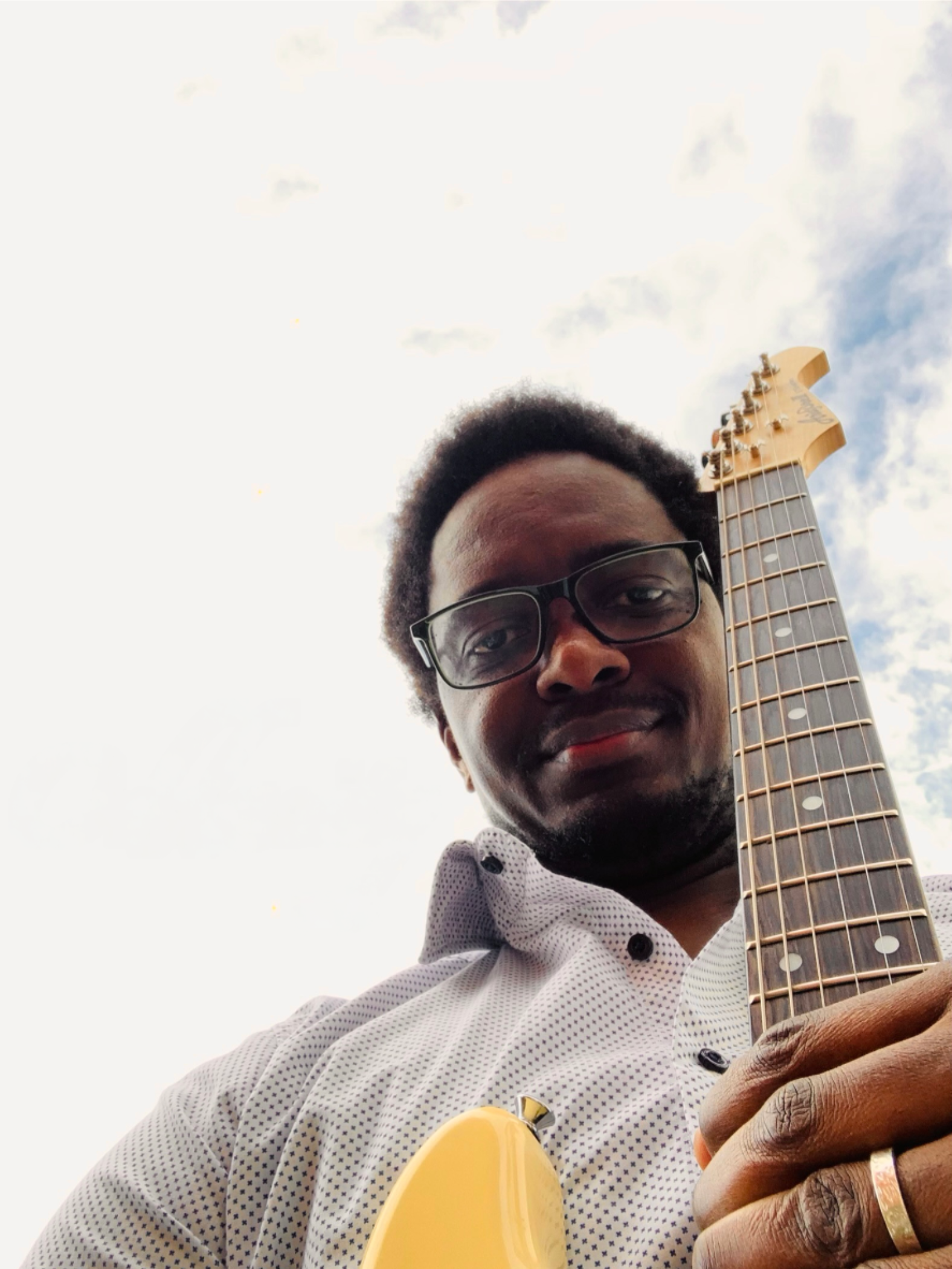
Ian Businge is a British-Ugandan jazz and jazz fusion guitarist based in Hayle, Cornwall. His playing reflects more than two decades of dedicated study and performance — rooted in the bebop tradition, a deep love of jazz harmony, and ongoing inspiration from Frank Gambale, Pasquale Grasso, and Craig Oxley.
He performs with a bespoke Digital Performance Environment that delivers ensemble-tier sound as a solo artist, and is an active member of the Musicians' Union and The Ivors Academy.
Guitar tuition in Cornwall
The Ian Businge Guitar Academy is now taking enquiries. In person across the west of Cornwall and online.
"For we are God's handiwork, created in Christ Jesus to do good works, which God prepared in advance for us to do." — Ephesians 2:10
The Artist
Ian Businge
To enrich and better lives through music.
To enrich and better lives through music.
Biography
Jazz from Cornwall
Ian Businge is a British-Ugandan guitarist based in Hayle, Cornwall. He has been playing jazz and jazz fusion seriously for over twenty years, and his music sometimes moves beyond those boundaries when the composition demands it. The music is always the point.
His Ugandan heritage forms an innate part of his perspective — present in the music, not announced. Inspired by Frank Gambale, Pasquale Grasso, and Craig Oxley, among many others who continue to shape how he hears and plays.
Ian performs with a bespoke Digital Performance Environment — a technological and musical system that delivers the footprint of a full jazz ensemble through a single artist. The result is a live sound that is simultaneously intimate and orchestral, always uncoloured, always direct.
He is a full member of the Musicians' Union and The Ivors Academy, a member of PRS for Music and PPL, and holds full Enhanced DBS certification. He is an active candidate for the Level 4 Certificate for Music Educators with Trinity College London and for the Open University's BA (Hons) Music programme.
Trinity College London — Level 4 CME, Active Candidate
The Open University — BA (Hons) Music, Active Candidate
The Australian jazz and fusion guitarist whose command of the instrument and approach to velocity continues to be a formative influence on Ian's playing.
II
Pasquale Grasso
Called by Pat Metheny "the best guitar player I've heard in maybe my entire life." Grasso's approach to bebop on the guitar — his depth of language and articulation — remains a constant and living reference.
III
Craig Oxley
A continuing influence on how Ian understands the relationship between jazz and the blues — harmonically, structurally, and in terms of feel.
Performances & availability
For weddings, recitals, residencies, workshops, or any other engagement — get in touch directly.
"For we are God's handiwork, created in Christ Jesus to do good works, which God prepared in advance for us to do." — Ephesians 2:10
Private Tuition · West Cornwall (St Ives) & Online
The Guitar Academy
Private guitar tuition from age 7. West Cornwall (St Ives) and online.
DBS Enhanced ·
Trinity College London CME Candidate ·
Africa Institute of Music ·
Guitar tuition from age 7 ·
West Cornwall & Online ·
DBS Enhanced ·
Trinity College London CME Candidate ·
Africa Institute of Music ·
Guitar tuition from age 7 ·
West Cornwall & Online ·
The approach
Taught with the same seriousness as the stage
The Ian Businge Guitar Academy offers private guitar tuition for students aged 7 and upwards — in person across the west of Cornwall, and online. Whether you are beginning or already playing, the Academy is built around one principle: structured progress through rigorous, well-designed teaching.
Ian brings the same depth and precision to his teaching that defines his playing. Lessons are not improvised — they follow a proven architecture that ensures every minute is used well.
Ian is an active candidate for the Trinity College London Level 4 Certificate for Music Educators, holds full Enhanced DBS certification, and has trained at the Africa Institute of Music.
The Academy
Lesson formats
Open to all · ages 7 and up
The Standard Academy
Open to students of any age and background who are serious about the guitar. Every lesson is structured, purposeful, and built to make progress inevitable. Three lesson formats are available depending on the student's age, stage, and availability.
30 min
A focused session well-suited to younger students or those with limited availability. Consistent and progressive.
45 min
The standard format. Enough time to warm up, work on repertoire, and apply theory — without overstretching concentration.
60 min
For students who want to go further in each session. Deeper repertoire work, more time for harmonic study and application.
The ethos
Accountability built in
Every lesson follows a clear, purposeful structure. Ian's teaching is designed so that students always know what they are working towards and why — progress is built into the architecture of each session, not left to chance.
Lessons run to a strict clock. Structure is not a constraint. It is how serious musicians work, and it is how serious students develop.
Get in touch
To enquire about availability or to find out more, get in touch. Ian responds to every message personally.
"For we are God's handiwork, created in Christ Jesus to do good works, which God prepared in advance for us to do." — Ephesians 2:10
Performances · Projects · Music
Portfolio & Gallery
A growing record of performances, recordings, and artistic projects. Updated as new work is released.
Photography
Portrait
Hayle, Cornwall
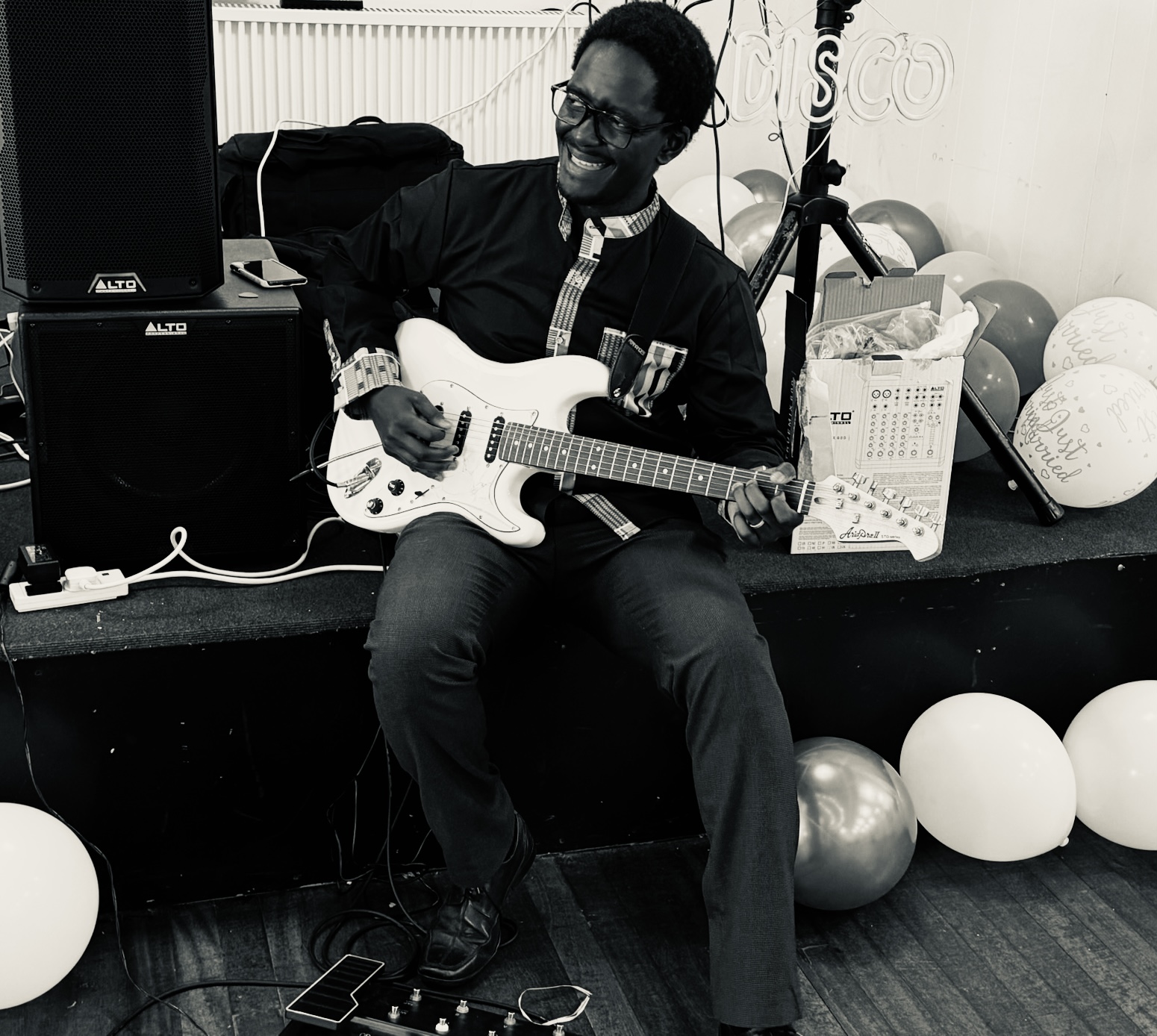
Performance
Live
Performance
Live Jazz
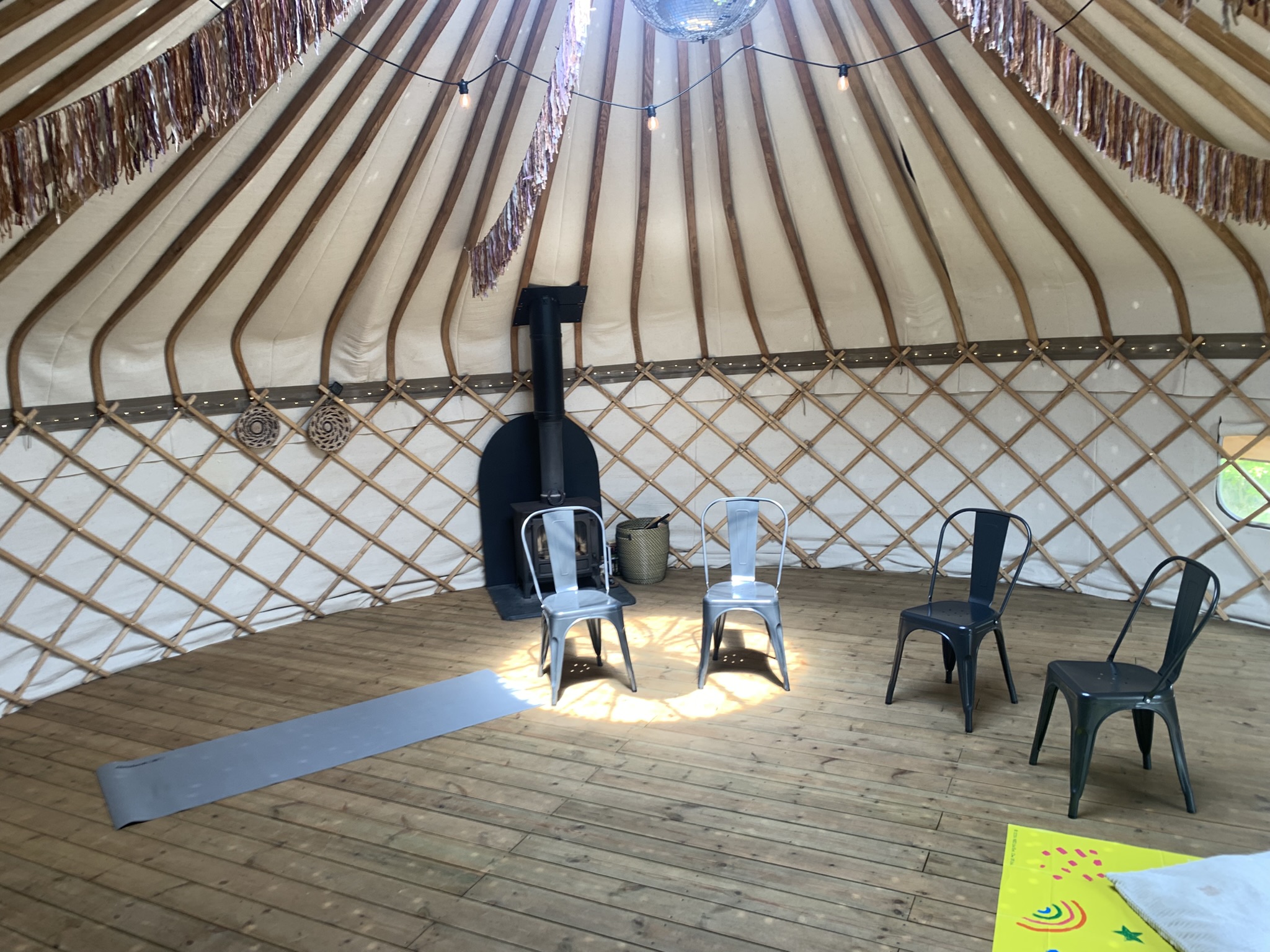
Outreach
NHS Coombe Away Day
Projects & Performances
The Work
2025
NHS Coombe Away Day — Rhythm & Collective Consciousness Workshop
A rhythm workshop exploring how music connects people and bridges cultures. Delivered to NHS Coombe staff in Cornwall.
2026
Royal Cornwall Wedding Show
Live performance showcase at the Royal Cornwall Wedding Show, June 2026. The Warm Wedding programme performed live for prospective clients.
Ongoing
Original Compositions — PRS Registered
A growing catalogue of original compositions and arrangements, registered with PRS for Music and available for licensing and sync.
"For we are God's handiwork, created in Christ Jesus to do good works, which God prepared in advance for us to do." — Ephesians 2:10
Thoughts & Reflections
The Journal
On jazz, harmony, guitar technique, life in Cornwall, and what it means to take the music seriously.
Featured
OutreachJune 2025
What a Rhythm Workshop Taught Me About the Collective Unconscious
When the NHS invited me to lead a rhythm workshop at the Coombe Away Day, I didn't expect the conversation to land where it did. Music is one of the fastest routes to genuine collective experience — something many of us are quietly starved of.
We worked with rhythm as a shared language. No instruments — just bodies, clapping, breathing, listening. Within twenty minutes the room had changed. People who had been sitting apart were leaning towards each other. Something had shifted without anyone having to say anything.
Dr Ellena B. said afterwards that it made her think about how music can connect minds and bridge cultures — a practical application of the idea of the collective unconscious. I couldn't have put it better myself.
All Articles
TechniqueMay 2026
Why Economy Picking Changed Everything
Frank Gambale codified something you can actually learn. Here is how I integrated it, and why it took longer than I expected.
Read →
Economy picking is one of those techniques that sounds simple until you try to do it. The principle is straightforward: rather than always alternating your pick strokes, you use a downstroke when crossing to a lower string and an upstroke when crossing to a higher one. You are, in effect, sweeping through string changes rather than fighting against them.
Frank Gambale didn't invent economy picking but he codified it, demonstrated it at extraordinary speed, and — crucially — recorded instructional material that made it learnable. His approach showed that the technique wasn't a shortcut. It was a discipline.
Why it took me longer than it should have
I spent years fighting my right hand. I had good alternate picking and I was reluctant to dismantle it. The mistake was thinking of economy picking as a replacement. It isn't. It sits alongside alternate picking — another tool, not a substitute. Once I understood that, the integration became much faster.
The real shift came when I stopped practising the technique in isolation and started applying it directly to jazz vocabulary I already knew. Familiar phrases, new motion. The ear guided the hand, and the hand gradually found its way.
HarmonyApril 2026
The Jazz-Blues Architecture That Underpins Everything
Craig Oxley's approach is not about playing blues over jazz changes. It is a deeper framework for understanding how harmony creates expectation and release.
Read →
There is a tendency to treat jazz and the blues as separate traditions that occasionally meet — jazz harmony up here, blues feeling down there, and the two shaking hands once in a while. Craig Oxley's work dismantles that separation entirely.
What Oxley articulates is that the blues is not a style you apply on top of jazz harmony. It is a structural principle that runs underneath it. The tension and release, the particular way certain notes push against the harmony before resolving — these are blues mechanics operating inside what we call jazz language.
What changes when you hear it this way
When you hear it Oxley's way, your relationship to chord tones changes. Notes that you might have treated as passing become load-bearing. The space between resolution points opens up. You start to hear where the blues lives inside a ii-V-I, which is everywhere, once you know where to look.
For me, this framework made the music feel less like a set of rules to follow and more like a physical thing — something with weight and pressure and direction. That is when playing started to feel honest rather than correct.
CornwallMarch 2026
On Being a Musician Here — Rooted in Cornwall
Cornwall asks something of you — a commitment to the people and places you serve. On what it means to show up fully, year after year, and let the music speak for itself.
Read →
When I first started thinking seriously about building a music career in Cornwall, I made the mistake of applying London logic to a Cornish reality. Volume of outreach. Broad social media presence. Maximum visibility. None of it landed the way I expected.
Cornwall is a high-trust, low-density market. People here make decisions relationally. They hire people they have met, been recommended, or seen perform. They do not respond to cold outreach the way urban markets sometimes do. The funnel is different.
What actually works
One conversation at the school gate — a real one, where someone asks about lessons for their child and you answer honestly and without a sales pitch — is worth more than twenty comments on a Facebook group. I have seen this play out repeatedly.
The implication is that the work of building a practice here is slower, more deliberate, and more personal than it would be elsewhere. That is not a disadvantage. It is simply the nature of the place. And once you have trust here, it tends to hold.
IdentityJanuary 2026
Heritage, Voice, and the Music That Shapes Me
Growing up between cultures gives you more to draw from, not less. On the Ugandan rhythms, British jazz tradition, and lifelong listening that flow together into a single musical voice.
Read →
There is a version of this article that is an exercise in grievance — a list of assumptions I have encountered, a catalogue of moments where someone's expectations of what I should be playing did not match what I was actually playing. I am not going to write that article.
My Ugandan heritage is real and it is present in my music. It shapes how I hear, what moves me, and the particular weight I bring to certain kinds of phrasing. But it is not a genre. It is not a product. And it is certainly not an invitation for other people to define what kind of musician I ought to be.
The only answer that works
The most effective response to any assumption about what a British-Ugandan guitarist should sound like is to play. Not to explain, not to argue, not to position. Just to play — at a level where the quality of the music is the only thing in the room.
That is the standard I hold myself to. It is the only one that matters, and the only one I can control.
Stay connected
Occasional notes on performances, new music, Academy availability, and thoughts on jazz. Infrequent. Worth reading.
"For we are God's handiwork, created in Christ Jesus to do good works, which God prepared in advance for us to do." — Ephesians 2:10
Enquiries & Bookings
Get in Touch
Every enquiry is answered personally. Ian will respond with everything you need.
Let's make something happen
Whether you are planning a wedding, considering guitar tuition, or have another idea entirely — Ian would like to hear from you.
Weddings, corporate events, jazz evenings, community performances. Get in touch to discuss your date.
"For we are God's handiwork, created in Christ Jesus to do good works, which God prepared in advance for us to do." — Ephesians 2:10
Transparency
Legal & Access
Accessibility Statement, Privacy Policy, and Terms of Use.
Accessibility
Accessibility Statement
Ian Businge Music is committed to making this website accessible to all visitors, regardless of ability or the technology they use. We believe that access to music and the arts should not be limited by barriers of any kind.
What we have implemented
This site has been built with the following accessibility features:
A skip navigation link at the top of every page, allowing keyboard and screen reader users to bypass the navigation menu and reach the main content directly.
Semantic HTML throughout — headings, landmarks, lists, and sections are structured to convey meaning to assistive technologies.
ARIA labels on interactive elements, navigation regions, and dynamic content to support screen reader users.
Keyboard navigation — all navigation links and interactive controls are operable via keyboard alone, with visible focus states.
Screen reader support — the site has been designed so that its content and structure are meaningful when read aloud by assistive software.
Colour contrast — text and background combinations have been chosen to maintain legible contrast ratios throughout.
Responsive design — the site adapts to all screen sizes and orientations, including mobile and tablet devices.
Alternative text on images used for informational purposes.
Our commitment
We are committed to continuous improvement. This site is reviewed and updated on an ongoing basis, and accessibility is considered in every change we make. We aim to meet the principles of the Web Content Accessibility Guidelines (WCAG) and will work towards greater conformance over time. We do not currently claim full WCAG 2.1 AA certification, as this requires a formal independent audit.
Encountered a barrier?
If you experience any difficulty accessing any part of this website, or if you have a suggestion for how we can improve, please contact us directly. We take all accessibility feedback seriously and will respond promptly.
This policy explains how Ian Businge Music collects, uses, and protects information in connection with this website. This site is operated as a sole trader business based in Hayle, Cornwall, United Kingdom.
Information we collect
We collect information you provide directly — for example, when you submit an enquiry via the contact form. This may include your name, email address, and the content of your message. We do not collect this information without your knowledge, and we do not sell or share it with third parties for marketing purposes.
Cookies and third-party services
This website uses a small number of third-party services to function. These services may set cookies on your device — small text files used to enable their features. We do not use cookies for advertising or behavioural tracking of our own.
When you visit this site, a cookie consent banner is displayed. You may accept or decline the use of non-essential cookies. Your choice is stored in your browser and the banner will not reappear. You may clear your browser's local storage at any time to reset your preference.
If you decline, this site will continue to function. Some third-party features may be limited.
Your rights
Under UK GDPR, you have the right to access, correct, or request deletion of any personal data we hold about you. To exercise any of these rights, please contact us at ian@ianbusingemusic.com.
Contact
For any privacy-related enquiry, please write to: ian@ianbusingemusic.com · Ian Businge Music · Hayle, Cornwall, UK.
Terms
Terms of Use
By accessing and using this website, you agree to the following terms. If you do not agree, please do not use this site.
Ownership and intellectual property
All content on this website — including text, images, audio, video, compositions, arrangements, and design — is the property of Ian Businge Music unless otherwise stated. All rights are reserved. No content may be reproduced, distributed, or used without prior written permission.
Musical compositions and recordings created by Ian Businge are registered with PRS for Music and PPL. Unauthorised use or reproduction of this material may constitute an infringement of copyright.
Use of this site
This website is provided for informational purposes and to facilitate genuine enquiries about performances, tuition, and related services. You agree not to use this site for any unlawful purpose or in any way that could damage, disable, or impair it.
Accuracy of information
We endeavour to keep the information on this site accurate and up to date. However, we make no warranty as to the completeness or accuracy of any content. Availability, pricing, and dates are subject to change without notice.
External links
This site contains links to third-party websites. These are provided for convenience only. Ian Businge Music is not responsible for the content or privacy practices of any external sites.
Governing law
These terms are governed by the laws of England and Wales. Any disputes shall be subject to the exclusive jurisdiction of the courts of England and Wales.
Changes to these terms
We reserve the right to update these terms at any time. Continued use of the site following any changes constitutes your acceptance of the revised terms. Last updated: May 2026.
"For we are God's handiwork, created in Christ Jesus to do good works, which God prepared in advance for us to do." — Ephesians 2:10
This site uses third-party services which may set cookies on your device. By accepting, you consent to their use. Learn more.